
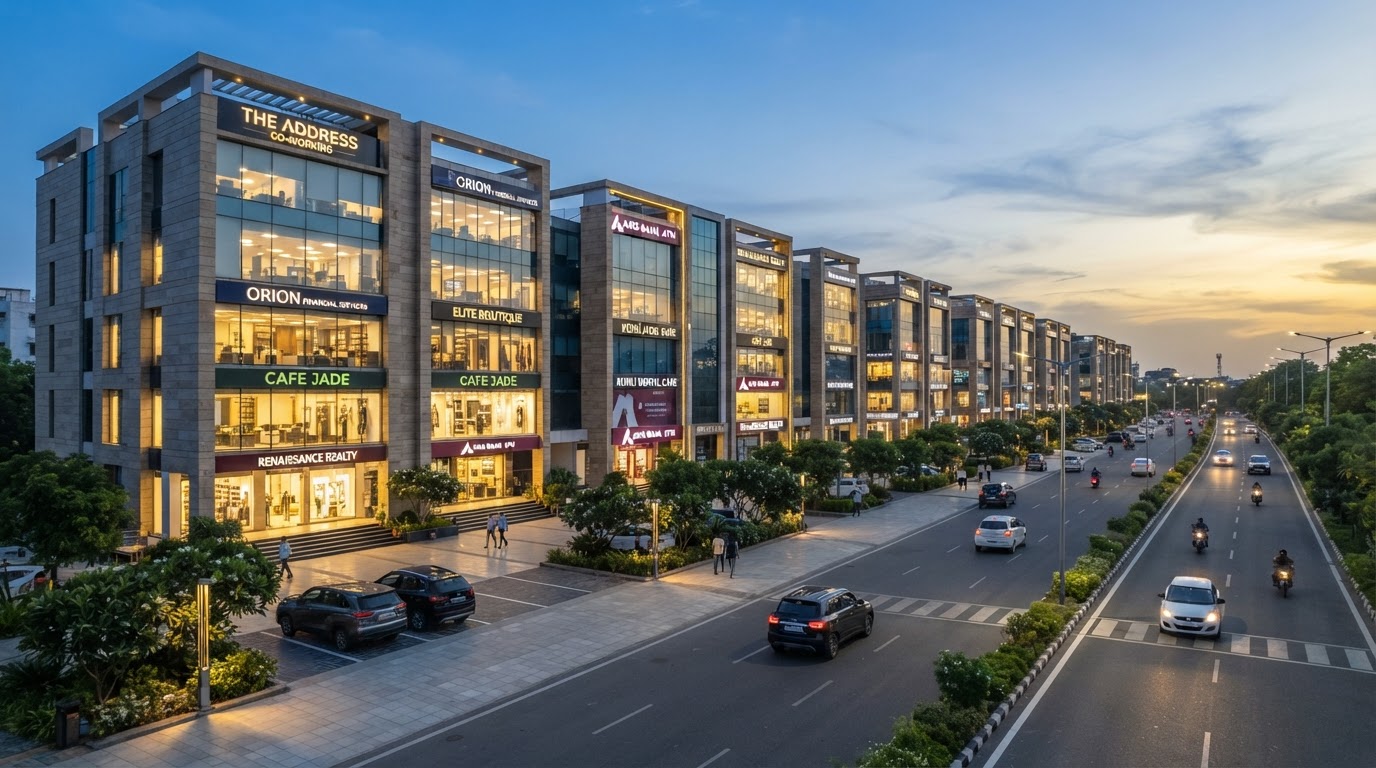
Commercial property in Panchkula is not a single market but several micro-markets stitched along its main roads and office belts. A main-road SCO, a high-street showroom, a shop in an established market, and an office in the MDC belt each answer a different business need — and each carries a different investment profile. Three decades of working this city's commercial side has taught us that the right commercial decision always starts with the use-case, never the headline yield.
The SCO — shop-cum-office — is the workhorse of Panchkula's commercial market. These units combine showroom and office space on main-road frontage, which is precisely why they hold value: frontage and footfall. For a business owner, an SCO puts your brand on a road people travel daily. For an investor, an SCO on a genuine main road tends to rent to businesses that need visibility, which sustains both rent and resale demand over time.
Frontage is the single factor that most shapes SCO value. A wider, more visible frontage draws more footfall and commands a stronger rent; a narrow or set-back unit on the same road underperforms. Before buying, stand on the road at different times and watch how people and traffic actually move past the unit. Neighbouring businesses matter too — a cluster of complementary shops creates a destination, where an isolated unit has to fight for every customer.
Showrooms and shops are the retail end of the same logic, and the distinction is operational more than legal. A showroom needs frontage, visibility and display depth for a product to be seen; a shop depends on footfall and easy access. Match the space to what you sell and how your customers arrive. Parking and loading access matter for both, and their absence can quietly cap a property's potential no matter how good the frontage looks.
Office space in the MDC belt answers a different demand entirely. The Modern Housing Complex area has become known for professional practices, clinics and service businesses that prefer a quieter, planned environment over busy main-road frontage. Demand here is driven by professionals who value parking, a calm setting and longer tenancies. Rents can be steadier than high-street retail because tenant profiles tend to be stickier, which suits investors who want income with less turnover.
For business owners, the own-versus-lease question turns on stability and capital. Owning gives you control of your premises and removes rent-escalation risk, but it ties up capital that might serve the business elsewhere. Leasing keeps capital free and offers flexibility, but exposes you to escalation and, eventually, to a landlord's decision. Match the property strategy to your business's growth plans and capital position — not to a generic preference for ownership.
For investors, commercial's higher headline yield comes paired with higher vacancy risk, and that pairing is the whole story. A single tenant loss can empty a quarter or more of a year's income, so tenant quality, lease length and the strength of the local business cycle matter as much as the rent. The investors who do well in commercial are the ones who underwrite the tenant and the location, not just the rate.
Zoning, parking and future road plans are the quiet risks worth checking on every commercial purchase. A unit that trades well today can be undercut by a road-widening notice, a parking shortage, or a change in permissible use. Verify what the property can be used for, what approvals exist, and what civic work is planned nearby. The frontage that feels valuable can lose value fast if the road in front of it changes.
Leasing terms deserve attention from both sides. Rent, security deposit, lock-in, escalation and maintenance responsibilities all shape the real return over a tenancy — not just the monthly number. Clear, written terms prevent the disputes that quietly erode commercial returns, and a professional review of a lease before signing protects both tenant and landlord. Exit and renewal clauses determine how flexible your position remains years in.
The thread running through all of it is simple: commercial property rewards the buyer who understands the specific use-case the space serves. Match the space to the business, match the asset to the investment goal, and check the fundamentals — frontage, footfall, zoning, tenant quality and clear terms — before committing. Do that, and Panchkula's commercial market offers genuinely dependable returns. Skip it, and even a strong-sounding yield can turn into an expensive vacancy.